ParallelSum[expr,{i,imax}]
evaluates in parallel the sum  .
.
ParallelSum[expr,{i,imin,imax},{j,jmin,jmax},…]
evaluates in parallel the multiple sum  .
.

ParallelSum
ParallelSum[expr,{i,imax}]
evaluates in parallel the sum  .
.
ParallelSum[expr,{i,imin,imax}]
starts with i=imin.
ParallelSum[expr,{i,imin,imax,di}]
uses steps di.
ParallelSum[expr,{i,{i1,i2,…}}]
uses successive values i1, i2, ….
ParallelSum[expr,{i,imin,imax},{j,jmin,jmax},…]
evaluates in parallel the multiple sum  .
.
Details and Options
- ParallelSum is a parallel version of Sum, which automatically distributes partial summations among different kernels and processors.
- ParallelSum will give the same results as Sum, except for side effects during the computation.
- Parallelize[Sum[expr,iter,…]] is equivalent to ParallelSum[expr,iter,…].
- If an instance of ParallelSum cannot be parallelized it is evaluated using Sum.
- The following options can be given:
-
Method Automatic granularity of parallelization DistributedContexts $DistributedContexts contexts used to distribute symbols to parallel computations ProgressReporting $ProgressReporting whether to report the progress of the computation - The Method option specifies the parallelization method to use. Possible settings include:
-
"CoarsestGrained" break the computation into as many pieces as there are available kernels "FinestGrained" break the computation into the smallest possible subunits "EvaluationsPerKernel"->e break the computation into at most e pieces per kernel "ItemsPerEvaluation"->m break the computation into evaluations of at most m subunits each Automatic compromise between overhead and load balancing - Method->"CoarsestGrained" is suitable for computations involving many subunits, all of which take the same amount of time. It minimizes overhead, but does not provide any load balancing.
- Method->"FinestGrained" is suitable for computations involving few subunits whose evaluations take different amounts of time. It leads to higher overhead, but maximizes load balancing.
- The DistributedContexts option specifies which symbols appearing in expr have their definitions automatically distributed to all available kernels before the computation.
- The default value is DistributedContexts:>$DistributedContexts with $DistributedContexts:=$Context, which distributes definitions of all symbols in the current context, but does not distribute definitions of symbols from packages.
- The ProgressReporting option specifies whether to report the progress of the parallel computation.
- The default value is ProgressReporting:>$ProgressReporting.
Examples
open all close allBasic Examples (1)

Options (9)
Method (2)
Calculations with vastly differing runtimes should be parallelized as finely as possible:
ParallelSum[N[Fibonacci[i]], {i, 1, 1000}, Method -> "FinestGrained"]A large number of simple calculations should be distributed into as few batches as possible:
ParallelSum[N[i * Pi], {i, 10 ^ 6}, Method -> "CoarsestGrained"]DistributedContexts (5)
By default, definitions in the current context are distributed automatically:
remote[x_] := {$KernelID, x ^ 3}ParallelSum[remote[i], {i, 4}]Do not distribute any definitions of functions:
local[x_] := {$KernelID, x ^ 2}ParallelSum[local[i], {i, 4}, DistributedContexts -> None]Distribute definitions for all symbols in all contexts appearing in a parallel computation:
a`f[x_] := {$KernelID, x}ParallelSum[a`f[i], {i, 4}, DistributedContexts -> Automatic]Distribute only definitions in the given contexts:
b`g[x_] := {$KernelID, -x}ParallelSum[b`g[i], {i, 4}, DistributedContexts -> {"a`"}]Restore the value of the DistributedContexts option to its default:
SetOptions[ParallelSum, DistributedContexts :> $DistributedContexts]ProgressReporting (2)
Do not show a temporary progress report:
ParallelSum[EulerPhi[i], {i, 2 * 10 ^ 7}, ProgressReporting -> False]Show a temporary progress report even if the default setting $ProgressReporting may be False:
ParallelSum[EulerPhi[i], {i, 2 * 10 ^ 7}, ProgressReporting -> True]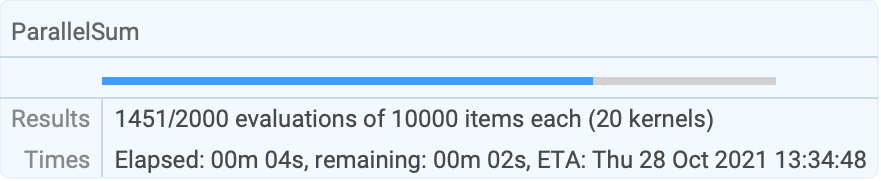
| |
Possible Issues (2)
Sums with trivial terms may be slower in parallel than sequentially:
AbsoluteTiming[ParallelSum[N[i], {i, 10 ^ 6}]]AbsoluteTiming[Sum[N[i], {i, 10 ^ 6}]]Splitting the computation into as few pieces as possible decreases the parallel overhead:
AbsoluteTiming[ParallelSum[N[i], {i, 10 ^ 6}, Method -> "CoarsestGrained"]]Sum may employ symbolic methods that are faster than an iterative addition of all terms:
AbsoluteTiming[ParallelSum[i, {i, 10 ^ 7}]]AbsoluteTiming[Sum[i, {i, 10 ^ 7}]]Text
Wolfram Research (2008), ParallelSum, Wolfram Language function, https://reference.wolfram.com/language/ref/ParallelSum.html (updated 2021).
CMS
Wolfram Language. 2008. "ParallelSum." Wolfram Language & System Documentation Center. Wolfram Research. Last Modified 2021. https://reference.wolfram.com/language/ref/ParallelSum.html.
APA
Wolfram Language. (2008). ParallelSum. Wolfram Language & System Documentation Center. Retrieved from https://reference.wolfram.com/language/ref/ParallelSum.html