

Quotient

例題
すべて開く すべて閉じる例 (2)
スコープ (16)
数値評価 (8)
Quotientは整数に使うことができる:
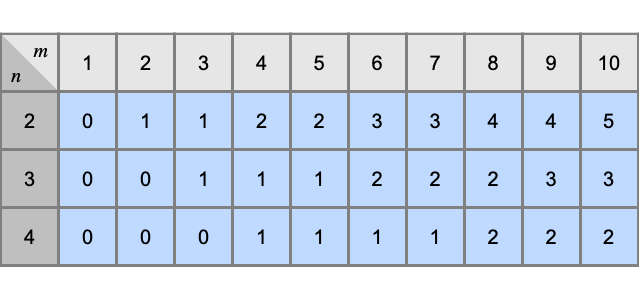
Quotient[13, 4]Quotient[19 / 3, 5 / 2]Quotient[4.56, 2.5]Quotient[E ^ E ^ E, Pi]Quotient[10.4 + 8I, 4. + 5I]Quotient[10 ^ 90, NextPrime[10 ^ 80]]Quotient[7, 3, 1]Quotientは要素単位でリストに縫い込まれる:
Quotient[{1, 2, 3, 4, 5, 6, 7, 8, 9, 10}, 3]記号演算 (8)
Reduce[Quotient[2x ^ 2 + 1, 2] == Quotient[3x ^ 3, x ^ 2] && x < 10, x]Refine[Quotient[2 n - 3, 7], (n + 2) / 7∈Integers]Simplify[Quotient[4 n + 5, 2], Element[n, Integers]]FunctionExpand[Quotient[m, n]]Quotientを区分関数として表す:
PiecewiseExpand[Quotient[2x + 1, 3], 0 < x < 5]Integrate[Quotient[n ^ 2, 3] ^ 2, {n, 0, 5}]DifferenceRootReduce[Quotient[n, 10], n]GeneratingFunction[Quotient[n, 5], n, x]アプリケーション (11)
基本的なアプリケーション (6)
Grid[Table[If[i * j == 0 , If[i + j == 0, "", Style[i + j, Red, Italic, Bold]], Quotient[i, j]], {i, 0, 10}, {j, 0, 10}], ...]MatrixPlot[Table[Quotient[a, b], {a, 20}, {b, 20}], PlotLegends -> Automatic]Plot[Quotient[x, 2], {x, -5, 5}]Plot[Quotient[x ^ 2, x - 1], {x, -2, 2}]Plot3D[Quotient[x y, Max[x, y]], {x, -5, 5}, {y, -5, 5}]Plot3D[Abs[Quotient[x + I y, 3 - 2I]], {x, -5, 5}, {y, -5, 5}]整数論 (5)
NestWhileListを使ってQuotientを正の引数について計算する:
myQuotient[m_, n_] := Length[NestWhileList[n + #&, n, # ≤ m&]] - 1;myQuotient[26, 7]Quotient[26, 7]m = 7;
n = 2;n * Quotient[m, n] + Mod[m, n] == m2か3で割り切れるが6では割り切れない1000未満の正の整数の数を数える:
With[{n = 1000}, Quotient[n, 2] + Quotient[n, 3] - 2Quotient[n, 6]]Count[Range[1000], n_ /; (Divisible[n, 2] || Divisible[n, 3]) && !Divisible[n, 6]]euclid[a_, b_] := FixedPointList[{#2, If[#2 == 0, 0, # - Quotient[##]#2]}&@@#&, {a, b}][[-3, 1]];euclid[12, 24]GCD[12, 24]Quotientを含む式を簡約する:
FullSimplify[Quotient[m + k n, n] == Quotient[m, n] + k, {m, n, k}∈Integers]FullSimplify[Quotient[a ^ 2 - b ^ 2, a - b], {a, b}∈Reals]特性と関係 (6)
QuotientRemainderの最初の部分はQuotientである:
First[QuotientRemainder[7, 2]]Quotient[7, 2]Quotient[m,n]は,整数についてはFloor[m/n]に等しい:
Quotient[83, 16]Floor[83 / 16]n*Quotient[m,n,d]+Mod[m,n,d]は常に m である:
FullSimplify[n Quotient[m, n, d] + Mod[m, n, d] == m, {m, n, d}∈Integers]Quotient[m,n]+FractionalPart[m/n]は,正の整数については常に  である:
Quotient[24, 7] + FractionalPart[24 / 7]PiecewiseExpandを使って区分関数として表す:
PiecewiseExpand[Quotient[2 x + 1, 3], 0 < x < 5]Quotientを含む式を簡約する:
FullSimplify[Quotient[m, n]∣m, n∣m && {m, n}∈Integers]FullSimplify[Quotient[a b, b], {a, b}∈Integers]考えられる問題 (1)
Quotientは自動的には値を簡約しない:
Quotient[2, 1 + (Pi + 1) ^ 2 - Pi ^ 2 - 2Pi - 1 + 10 ^ -100]
Simplify[%]インタラクティブな例題 (1)
おもしろい例題 (2)
Quotientのフーリエ(Fourier)変換の引数をプロットする:
ArrayPlot[Arg[Fourier[Table[Quotient[m, 12n], {m, 100}, {n, 100}]]]]Quotientのウラム(Ulam)螺線をプロットする:
ulam[n_] := Partition[Permute[Range[n ^ 2], Accumulate[Take[Flatten[{{n ^ 2 + 1} / 2, Table
[(-1) ^ j i, {j, n}, {i, {-1, n}}, {j}]}], n ^ 2]]], n]ArrayPlot[Quotient[ulam[61], 450], ColorFunction -> "BlueGreenYellow"]
 MathWorld

 The Wolfram Functions Site

 NKS|Online
テキスト
Wolfram Research (1988), Quotient, Wolfram言語関数, https://reference.wolfram.com/language/ref/Quotient.html (2002年に更新).
CMS
Wolfram Language. 1988. "Quotient." Wolfram Language & System Documentation Center. Wolfram Research. Last Modified 2002. https://reference.wolfram.com/language/ref/Quotient.html.
APA
Wolfram Language. (1988). Quotient. Wolfram Language & System Documentation Center. Retrieved from https://reference.wolfram.com/language/ref/Quotient.html