
CoplanarPoints
CoplanarPoints[{p1,p2,p3,p4,…,pn}]
点 p1,p2,p3,p4,…,pnが共面かどうかを調べる.
詳細
- CoplanarPointsは線形従属としても知られている.
- 点集合が同一平面上にあるかどうかを調べる際に使われることが多い.
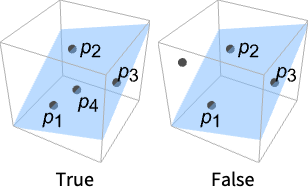
- CoplanarPoints[{p1,p2,p3,p4,…,pn}]は,点 p4,…,pnが点 p1,p2,p3を通る平面上にある場合はTrueを返す.
- 点 p1,p2,p3,p4が共面であるとき,行列{p2-p1,p3-p1,p4-p1}の階数は2以下である.
例題
すべて開く すべて閉じる例 (2)
点{0,0,0}, {1,1,-2}, {-1,2,-1}, {3,-4,1}は同一面上にある:
pts = {{0, 0, 0}, {1, 1, -2}, {-1, 2, -1}, {3, -4, 1}};CoplanarPoints[pts]Graphics3D[{InfinitePlane[pts[[1 ;; 3]]], Red, Point[pts]}]点{0,0,0}, {1,1,-2}と{-1,2,-1}を含む平面の方程式を求める:
CoplanarPoints[{{0, 0, 0}, {1, 1, -2}, {-1, 2, -1}, {x, y, z}}]スコープ (4)
CoplanarPointsは二次元の点に使うことができる:
CoplanarPoints[{{1, 2}, {3, 4}, {5, 6}}]CoplanarPoints[{{1, 2, 1}, {3, 4, 1}, {5, 6, 1}, {7, 8, 1}}]CoplanarPoints[{{0, 0, 1, 1}, {1, 0, 1, 0}, {0, 1, 0, 1}, {0, 1, 1, 1}, {0, 0, 0, 1}}]CoplanarPointsは数値座標に使うことができる:
CoplanarPoints[{{1, 2}, {3, 4}, {5, 6}}]CoplanarPoints[{{1, a, 1}, {a, 2, 1}, {1, 2, 1}, {a, b, c}}]座標集合上のCoplanarPoints:
CoplanarPoints[{{1, 2, 1}, {3, 4, 1}, {5, 6, 1}, {7, 8, 1}}]CoplanarPoints[{Point[{b, 0, 1}], Point[{a, 1, 1}], Point[{a, 3, 1}], Point[{a, b, c}]}]CoplanarPoints[Point[{{b, 0, 1}, {a, 1, 1}, {a, 3, 1}, {a, b, c}}]]CoplanarPointsは大きい集合に使うことができる:
pts = RandomPoint[Polygon[{{0, 0, 0}, {1, 0, 0}, {1, 1, 0}}], 10 ^ 6];CoplanarPoints[pts]//AbsoluteTimingアプリケーション (5)
基本的なアプリケーション (4)
CoplanarPoints[{{0, 0, 0}, {0, 1, 0}, {a, 2, b}, {c, 3, d}}]{{a, 2, b}, {c, 3, d}} /. FindInstance[% && a ≠ 0, {a, b, c, d}, Reals, 3]CoplanarPoints[{{1, 2}, {3, 4}, {5, 6}}]CoplanarPoints[RandomPoint[Disk[], 5000]]CoplanarPoints[RandomReal[1, {5000, 2}]]pts = {{0, 0, 0}, {1, 1, -2}, {-1, 2, -1}};CoplanarPoints[Append[pts, {x, y, z}]]pts = {{0, 0, 0}, {1, 0, 0}, {1, 1, 1}};CoplanarPoints[pts]Graphics3D[{InfinitePlane[pts], Red, PointSize[Large], Point[pts]}]幾何 (1)
poly = OuterPolyhedron[Polyhedron[{{-1/2, -1/2, -1/2}, {-1/2, -1/2, 1/2}, {-1/2, 1/2, -1/2}, {-1/2, 1/2, 1/2},
  {1/2, -1/2, -1/2}, {1/2, -1/2, 1/2}, {1/2, 1/2, -1/2}, {1/2, 1/2, 1/2}},
{{8, 4, 2, 6}, {8, 6, 5, 7}, {8, 7, 3, 4}, {4, 3, 1, 2}, {1, 3, 7, 5}, {2, 1, 5, 6}}]];faces = poly[[2]]CoplanarPoints[PolyhedronCoordinates[poly][[#]]]& /@ faces特性と関係 (5)
PositivelyOrientedPointsは共面の点に対してはFalseを返す:
pts = {{0, 0, 0}, {1, 1, -2}, {-1, 2, -1}, {3, -4, 1}};{CoplanarPoints[pts], PositivelyOrientedPoints[pts]}NegativelyOrientedPointsは共面の点に対してはFalseを返す:
pts = {{0, 0, 0}, {1, 1, -2}, {-1, 2, -1}, {3, -4, 1}};{CoplanarPoints[pts], NegativelyOrientedPoints[pts]}pts = RandomPoint[Line[{{0, 0, 0}, {1, 1, 1}}], 5];{CollinearPoints[pts], CoplanarPoints[pts]}RegionMemberを使って点が共面かどうか調べる:
RegionMember[Line[{{0, 0, 1}, {1, 1, 1}}], {2, 2, 1}]CoplanarPoints[{{0, 0, 1}, {1, 1, 1}, {2, 2, 1}}]InfinitePlaneを使ってグラフィック画像を描画する:
pts = {{0, 0, 0}, {1, 0, 0}, {1, 1, 1}};Graphics3D[{InfinitePlane[pts], Red, PointSize[Large], Point[pts]}]テキスト
Wolfram Research (2020), CoplanarPoints, Wolfram言語関数, https://reference.wolfram.com/language/ref/CoplanarPoints.html.
CMS
Wolfram Language. 2020. "CoplanarPoints." Wolfram Language & System Documentation Center. Wolfram Research. https://reference.wolfram.com/language/ref/CoplanarPoints.html.
APA
Wolfram Language. (2020). CoplanarPoints. Wolfram Language & System Documentation Center. Retrieved from https://reference.wolfram.com/language/ref/CoplanarPoints.html