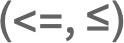



LessEqual

更多信息
- LessEqual 亦称为弱不相等或严格不相等.
- x≤y 可以输入为 x
 <=
 y 或 x \[LessEqual]y.
- 当自变量是实数时,LessEqual 给出 True 或 False.
- 当自变量不是数字时,LessEqual 进行一些化简.
- 对于精确数值,LessEqual 内部使用数值逼近建立数值排序. 这个过程可以通过设置全局变量 $MaxExtraPrecision 进行.
- 在 StandardForm 中,LessEqual 使用 ≤ 显示.
- 输入为 x
 </
 y 或 x \[LessSlantEqual] y 的 x≤y 用在输入中作为 x≤y 的替换.
范例
打开所有单元 关闭所有单元基本范例 (2)
范围 (9)
数值不等式 (7)
I ≤ 0
3 / 2 ≤ 5 / 3仅在至多最后 8 个二进制数位不相同的近似数被认为是相等的:
1. ≤ 1. - 2 ^ 7 10 ^ -161. ≤ 1. - 2 ^ 8 10 ^ -16N[Pi, 20] ≤ PiN[Pi, 20] ≤ Pi(1 - 2 ^ 8 10 ^ -20)Pi ^ E ≤ E ^ PiSqrt[2] + Sqrt[3] ≤ Sqrt[5 + 2Sqrt[6]]用 LessEqual 的符号方法和数值方法不足以反证这个不等式:
Sqrt[2] + Sqrt[3] ≤ Root[# ^ 4 - 10# ^ 2 + 1&, 4]
用 RootReduce 确定代数数的符号:
RootReduce[%[[1]] - %[[2]]] ≤ 0LessEqual 使用的数值方法没有提供足够的精度来证明这个不等式:
Sqrt[2] + Sqrt[3] ≤ Root[# ^ 4 - 10# ^ 2 + 1&, 4] - 10 ^ -100
RootReduce 用明确的方法证明不等式:
RootReduce[%[[1]] - %[[2]]] ≤ 0增加 $MaxExtraPrecision 也可以证明这个不等式:
Block[{$MaxExtraPrecision = 100}, Sqrt[2] + Sqrt[3] ≤ Root[# ^ 4 - 10# ^ 2 + 1&, 4] - 10 ^ -100]符号不等式 (2)
x ≤ x假定 x 是一个实数,用 Refine 重新计算不等式:
Refine[%, Element[x, Reals]]ineq = 1 ≤ x ^ 2 + y ^ 2 ≤ 2用 Reduce 求解集的一个明确描述:
Reduce[ineq, {x, y}]用 FindInstance 求一个实例:
FindInstance[ineq, {x, y}]在不等式定义的区域上,用 Minimize 优化:
Minimize[{x ^ 2 - y ^ 2, ineq}, {x, y}]在不等式定义的假设条件下,用 Refine 化简:
Refine[Sqrt[(2 - x ^ 2) ^ 2], ineq]属性和关系 (12)
二元参数 LessEqual 的否定形式是 Greater:
Not[x ≤ y]三元参数 LessEqual 的否定形式不能自动化简:
Not[x ≤ y ≤ z]通过 LogicalExpand 用二元参数 Greater 来表示它:
LogicalExpand[%]这不等于三元参数 Greater:
LogicalExpand[x > y > z]当 LessEqual 不能确定数值表达式之间的不等性时,将返回原式:
a = Log[Sqrt[2] + Sqrt[3]];
b = Log[5 + 2Sqrt[6]] / 2;
a ≤ b
FullSimplify 用精确的符号转换来证明这个不等式:
FullSimplify[%]NonPositive[x] 等价于  :
NonPositive /@ {-1, 0, 1, I}用 Reduce 求解不等式:
Reduce[x ^ 5 - 3x + 2 ≤ 0, x]Reduce[y ^ 2 - 4x ^ 2 + 4x ^ 4 ≤ 0, {x, y}]用 FindInstance 求一个实例:
FindInstance[y ^ 2 - 4x ^ 2 + 4x ^ 4 ≤ -z ^ 2, {x, y, z}]用 RegionPlot 和 RegionPlot3D 可视化显示不等式的解集:
RegionPlot[y ^ 2 - 4x ^ 2 + 4x ^ 4 ≤ 0, {x, -1, 1}, {y, -1, 1}]RegionPlot3D[y ^ 2 - 4x ^ 2 + 4x ^ 4 ≤ -z ^ 2, {x, -1, 1}, {y, -1, 1}, {z, -1, 1}]Refine[Sqrt[x ^ 2], x ≤ 0]Limit[a ^ n, n -> Infinity, Assumptions -> -1 / 2 ≤ a ≤ 1 / 2]用 Minimize 和 Maximize 来求解不等式约束条件下的优化问题:
Minimize[{x - y, y ^ 2 - 4x ^ 2 + 4x ^ 4 ≤ 0}, {x, y}]用 NMinimize 和 NMaximize 数值求解约束条件下的优化问题:
NMinimize[{x - y, 1 ≤ Tan[x] + Tan[y] ≤ 2}, {x, y}]在不等式解集上的对函数进行 Integrate 操作:
Integrate[x ^ 2 Boole[1 ≤ x ^ 2 + y ^ 2 ≤ 2], {x, -Infinity, Infinity}, {y, -Infinity, Infinity}]将 Median,Quantile 和 Quartiles 用于 
 个最大数:
{x1, x2, x3} = {1, 2, 3};x1 ≤ x2 ≤ x3Median[{x2, x3, x1}]可能存在的问题 (3)
2.00006 - 2.00005 ≤ 0.000012.00006 - 2.00005//InputForm2.00006`16 - 2.00005`16 ≤ 0.00001`16由于自动精度跟踪,LessEqual 明确前 10 个数位:
Precision[2.00006`16 - 2.00005`16]2.6 - 2.5 ≤ 0.1在这个例子中额外的数字被 LessEqual 忽略:
2.6 - 2.5//InputForm文本
Wolfram Research (1988),LessEqual,Wolfram 语言函数,https://reference.wolfram.com/language/ref/LessEqual.html (更新于 1996 年).
CMS
Wolfram 语言. 1988. "LessEqual." Wolfram 语言与系统参考资料中心. Wolfram Research. 最新版本 1996. https://reference.wolfram.com/language/ref/LessEqual.html.
APA
Wolfram 语言. (1988). LessEqual. Wolfram 语言与系统参考资料中心. 追溯自 https://reference.wolfram.com/language/ref/LessEqual.html 年