TransformationFunction


TransformationFunction
TransformationFunction[data]
表示应用于几何或其他变换的变换函数.
更多信息
- TransformationFunction[…] 对象由构造函数(如 TranslationTransform、RotationTransform 等)生成.
- TransformationFunction[…][x] 将转换函数应用于向量 x,返回转换后的向量.
- TransformationFunction[…][{x1,x2,…}] 对向量列表的每个向量 xi 应用变换,生成转换后的向量列表.
- TransformationFunction 适用于数值和符号向量,表示线性分式变换
 ,其中 A∈Matrices[{m,n}], b∈Matrices[{m,1}],c∈Matrices[{1,n}] 且 d∈Matrices[{1,1}].
- 对于较小的维度,通常显示为
 转换矩阵
 . TransformationMatrix 可用于提取变换矩阵.
- Composition[t1,t2] (其中 ti 具有转换矩阵
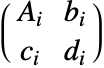 )给出新的 TransformationFunction 对象,其转换矩阵为
 .
- InverseFunction[t] (其中 t 具有转换矩阵
 )给出新的 TransformationFunction 对象,其转换矩阵为
 ,其中
 为矩阵的逆.
- 当仅限于仿射变换时,GeometricTransformation 可用于表示将 TransformationFunction 对象应用于几何或图形对象的效果.
- TransformationFunction[…][prop] 给出变换属性 prop. 对带有变换矩阵
 的变换函数,属性包括:
-
"AffineQ" 无论该变换在结构上是否仿射,如果 c 和 d 均为零,则结果为 True "AffineMatrix" 矩阵 A "AffineVector" 向量 b "FractionalVector" 向量 c "FractionalConstant" 常量 d "ArgumentLength" 向量 x 的长度 n "ResultLength" 结果向量的长度 m "TransformationMatrix" 
范例
打开所有单元 关闭所有单元基本范例 (1)
范围 (15)
创建 TransformationFunction (10)
t = TranslationTransform[{qx, qy, qz}]t[{x, y, z}]
r = RotationTransform[θ, {0, 0, 1}]r[{x, y, z}]ScalingTransform[{sx, sy}]
ShearingTransform[θ, {1, 0}, {0, 1}]
ReflectionTransform[{0, 0, 1}]缩放矩形 [xmin, xmax][ymin, ymax] 为单位正方形:
RescalingTransform[{{xmin, xmax}, {ymin, ymax}}]t = LinearFractionalTransform[{{1, 2, 3}, {4, 5, 6}, {7, 8, 9}}]t[{x, y}]tl = LinearFractionalTransform[{ Array[Subscript[a, #1, #2]&, {2, 2}] }]tl[{x, y}]ta = LinearFractionalTransform[{ Array[Subscript[a, #1, #2]&, {2, 2}], Array[Subscript[b, #]&, {2}] }]ta[{x, y}]tlft = LinearFractionalTransform[{Array[Subscript[a, #1, #2]&, {2, 2}], Array[Subscript[b, #]&, {2}], Array[Subscript[c, #]&, {2}]}]tlft[{x, y}]把 TransformationFunction 当作一个函数 (4)


t = RotationTransform[π / 3., {0, 0, 1}]
t[{1, 0, 0}]vl = RandomReal[1, {10, 3}];t[vl]t1 = RotationTransform[θ]t2 = RotationTransform[ϕ]Composition[t1, t2]//Simplifyt = RotationTransform[θ]it = InverseFunction[t]//SimplifyComposition[it, t]//Simplify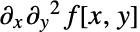
f = TransformationFunction[{{1, 2, 3}, {4, 5, 6}, {7, 8, 9}}]Derivative[{1, 2}][f]把 TransformationFunction 当作一个公式 (1)
t = LinearFractionalTransform[{ {{1, 2}, {3, 4}}, {1, 2}, {3, 1} }]f = t[{x, y}]D[f, {x, 2}]Limit[f, x -> 1]Integrate[f, x]Plot3D[f, {x, -1, 1}, {y, -1, 1}, PlotStyle -> {Red, Green}, Exclusions -> {1 + 3x + y == 0}]应用 (2)
TransformationFunction 可作为 GeometricTransformation 的参数:
t = AffineTransform[{DiagonalMatrix[{2, 2, 1}], {1, 1, 1}}]Graphics3D[GeometricTransformation[Cylinder[], t], Axes -> True]Integrate[(x ^ 3 + y ^ 3)Boole[x / 2 < y < x / 2 + 3 / 4 && y / 2 < x < y / 2 + 3 / 4], {x, 0, 3 / 2}, {y, 0, 3 / 2}]
t = AffineTransform[{{1, 1 / 2}, {1 / 2, 1}}]fuv = x ^ 3 + y ^ 3 /. Thread[{x, y} -> t[{u, v}]]jac = Det[TransformationMatrix[t]]Integrate[fuv Abs[jac], {u, 0, 1}, {v, 0, 1}]属性和关系 (1)

 次幂:
t = LinearFractionalTransform[{{-3, 2, 1}, {0, 1, 1}, {4, -2, -4}}]tt[n_] := LinearFractionalTransform[MatrixPower[TransformationMatrix[t], n]]Nest[Together@t@#&, {x0, y0}, 5]tt[5][{x0, y0}]% == %%//Simplify用 RSolve 找到第  项迭代:
RSolve[Thread /@ {{x[n + 1], y[n + 1]} == t[{x[n], y[n]}], {x[0], y[0]} == {x0, y0}}, {x, y}, n]{x[5], y[5]} /. %[[1]]//Simplify
Wolfram Research (2007),TransformationFunction,Wolfram 语言函数,https://reference.wolfram.com/language/ref/TransformationFunction.html (更新于 2019 年).
文本
Wolfram Research (2007),TransformationFunction,Wolfram 语言函数,https://reference.wolfram.com/language/ref/TransformationFunction.html (更新于 2019 年).
CMS
Wolfram 语言. 2007. "TransformationFunction." Wolfram 语言与系统参考资料中心. Wolfram Research. 最新版本 2019. https://reference.wolfram.com/language/ref/TransformationFunction.html.
APA
Wolfram 语言. (2007). TransformationFunction. Wolfram 语言与系统参考资料中心. 追溯自 https://reference.wolfram.com/language/ref/TransformationFunction.html 年