
ConicHullRegion
ConicHullRegion[{p1,…,pm+1}]
点 piを通る m 次元アフィン包領域を表す.
ConicHullRegion[p,{v1,…,vm}]
点 p を通り viと平行な m 次元アフィン包領域を表す.
ConicHullRegion[{p1,…,pm+1},{w1,…,wn}]
m 次元アフィン包にベクトル wjで生成された錐包を加えた領域を表す.
ConicHullRegion[p,{v1,…,vm},{w1,…,wn}]
m 次元アフィン包にベクトル wjで生成された錐包を加えた領域を表す.
詳細
- ConicHullRegionは,アフィン空間,半空間,特殊ケースのアフィン包としても知られている.
- ConicHullRegionは,幾何学領域およびグラフィックスプリミティブとして使うことができる.
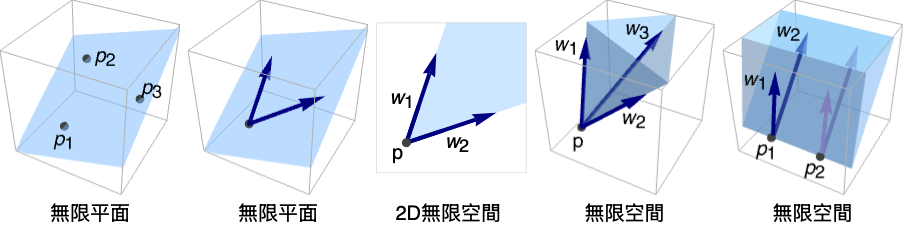
- ConicHullRegion[{p1,…,pm+1}]およびConicHullRegion[p,{v1,…,vm}]は,アフィン包を表す.これは,一般に,無限線,無限平面,あるいは無限空間として知られているものである.
- 円錐方向 wjは,アフィン包内の各点に加えられる純粋な錐包
 を表す.これは,アフィン包および錐包のMinkowski和としても知られている.
 - パラメータ表現は以下で与えられる.
-
ConicHullRegion[{p1,…,pm+1}] 
ConicHullRegion[p,{v1,…,vm}] 
ConicHullRegion[{p1,…,pm+1},{w1,…,wn}] 
ConicHullRegion[p,{v1,…,vm},{w1,…,wn}] 
- ConicHullRegionの低次元バージョンには特別な表し方がある.
-
ConicHullRegion[{p1,p2}] InfiniteLine[{p1,p2}] ConicHullRegion[{p1,p2,p3}] InfinitePlane[{p1,p2,p3}] ConicHullRegion[{p1},{w1}] HalfLine[p1,w1] ConicHullRegion[{p1,p2},{w1}] HalfPlane[{p1,p2},w1] - ConicHullRegion[p,{v1,…,vm}]は,viが線形独立の場合は m 次元領域を表す.
- ConicHullRegionはGraphicsおよびGraphics3Dで使うことができる.
- グラフィックスでは,点 p,piおよびベクトル vi,wjはDynamic式でよい.
- グラフィックスの描画は,FaceForm,EdgeForm,Opacity,色等の指示子の影響を受ける.
例題
すべて開く すべて閉じる例 (3)
2DにおけるConicHullRegion:
Graphics[ConicHullRegion[{{0, 0}}, {{1, -1}, {1, 1}}]]Graphics3D[ConicHullRegion[{{0, 0, 0}}, {{-10, 2, 3}, {1, 1, 0}}]]ℛ = ConicHullRegion[{{0, 0}}, {{1, -1}, {1, 1}}];{Graphics[{Pink, ℛ}], Graphics[{EdgeForm[Thick], Pink, ℛ}], Graphics[{EdgeForm[Dashed], Pink, ℛ}], Graphics[{EdgeForm[Directive[Thick, Dashed, Blue]], Pink, ℛ}]}ℛ = ConicHullRegion[{{0, 0}}, {{1, -1}, {1, 1}}];{RegionMember[ℛ, {1, 0}], RegionMember[ℛ, {-1, 0}]}スコープ (25)
グラフィックス (15)
指定 (7)
ill = Graphics[{PointSize[Medium], Point[{{1, 1}, {3, 2}}]}, PlotRange -> {{0, 4}, {0, 3}}, Frame -> True];Show[ill, Graphics[ConicHullRegion[{{1, 1}, {3, 2}}]]]ill = Graphics[{PointSize[Medium], Point[{{1, 1}}], Arrowheads[Medium], Thick, Arrow[{{1, 1}, {3, 2}}]}, PlotRange -> {{0, 4}, {0, 3}}, Frame -> True];Show[ill, Graphics[ConicHullRegion[{1, 1}, {{2, 1}}]]]ill = Graphics[{PointSize[Medium], Point[{{0, 0}}], Arrowheads[Medium], Thick, Arrow[{{0, 0}, {1, 0}}], Arrow[{{0, 0}, {0, 1}}]}];Show[Graphics[{Pink, ConicHullRegion[{0, 0}, {{1, 0}}, {{0, 1}}]}, PlotRange -> {{-1, 2}, {-1, 2}}, Frame -> True], ill]ill = Graphics[{PointSize[Medium], Point[{{0, 0}}], Arrowheads[Medium], Thick, Arrow[{{0, 0}, {1, 1}}], Arrow[{{0, 0}, {-1, 1}}]}];Show[Graphics[{Pink, ConicHullRegion[{{0, 0}}, {{1, 1}, {-1, 1}}]}, PlotRange -> {{-2, 2}, {-1, 2}}, Frame -> True], ill]

ill = Graphics3D[{PointSize[Medium], Point[{{1, 1, 1}, {2, 3, 4}}]}, PlotRange -> 5, Axes -> True];Show[ill, Graphics3D[ConicHullRegion[{{1, 1, 1}, {2, 3, 4}}]]]
ill = Graphics3D[{PointSize[Medium], Point[{{1, 1, 1}}], Arrowheads[Medium], Thick, Arrow[{{1, 1, 1}, {2, 3, 4}}]}, PlotRange -> 5, Axes -> True];Show[ill, Graphics3D[ConicHullRegion[{1, 1, 1}, {{1, 2, 3}}]]]


ill = Graphics3D[{PointSize[Medium], Point[{{0, 1, 3}, {1, 0, 1}, {1, 2, 3}}]}, PlotRange -> {{-1, 2}, {-1, 3}, {0, 4}}, Axes -> True];Show[ill, Graphics3D[{Opacity[0.5], ConicHullRegion[{{0, 1, 3}, {1, 0, 1}, {1, 2, 3}}]}]]ill = Graphics3D[{PointSize[Medium], Point[{{0, 1, 3}}], Arrowheads[Medium], Thick, Arrow[{{0, 1, 3}, {1, 0, 1}}], Arrow[{{0, 1, 3}, {1, 2, 3}}]}, PlotRange -> {{-1, 2}, {-1, 3}, {0, 4}}, Axes -> True];Show[ill, Graphics3D[{Opacity[0.5], ConicHullRegion[{0, 1, 3}, {{1, -1, -2}, {1, 1, 0}}]}]]


ill = Graphics3D[{PointSize[Medium], Point[{{0, 0, 0}}], Arrowheads[Medium], Thick, Arrow[{{0, 0, 0}, {0, 1, 2}}], Arrow[{{0, 0, 0}, {1, 2, 0}}]}, PlotRange -> {{-1, 3}, {-1, 3}, {-1, 3}}, Axes -> True];Show[ill, Graphics3D[ConicHullRegion[{{0, 0, 0}}, {{0, 1, 2}, {1, 2, 0}}]]]3D半空間は,1つの点,2つのベクトル,円錐方向によって定義できる:
Graphics3D[ConicHullRegion[{0, 0, 0}, {{1, 0, 0}, {0, 1, 0}}, {{0, 0, 1}}]]3D無限空間は,1つの点といくつかの円錐方向によって定義できる:
Graphics3D[ConicHullRegion[{{0, 0, 0}}, {{1, 1, 0}, {0, 1, 1}, {1, 0, 1}}]]スタイリング (7)
Table[Graphics[{Thickness[i], ConicHullRegion[{{0, 0}, {2, 1}}]}], {i, {Tiny, Small, Medium, Large}}]Table[Graphics[{t, ConicHullRegion[{{0, 0}, {2, 1}}]}], {t, {Thin, Thick}}]Table[Graphics[{Thickness[i], ConicHullRegion[{{0, 0}, {2, 1}}]}], {i, {.005, .05, .1}}]Table[Graphics[{AbsoluteThickness[i], ConicHullRegion[{{0, 0}, {2, 1}}]}], {i, {1, 5, 10}}]破線あるいは点線スタイルを使って1Dの錐包領域を描画することができる:
Table[Graphics[{Dashing[i], ConicHullRegion[{{0, 0}, {2, 1}}]}], {i, {Tiny, Small, Medium, Large}}]Table[Graphics[{d, ConicHullRegion[{{0, 0}, {2, 1}}]}], {d, {Dotted, Dashed, DotDashed}}]Table[Graphics[{c, ConicHullRegion[{{0, 0}, {2, 1}}]}], {c, {Red, Green, Blue, Yellow}}]Table[Graphics[{c, ConicHullRegion[{{0, 0}}, {{1, -1}, {1, 2}}]}], {c, {Red, Green, Blue, Yellow}}]Table[Graphics3D[{c, ConicHullRegion[{{1, 0, 0}, {1, 1, 1}, {0, 0, 1}}]}], {c, {Red, Green, Blue, Yellow}}]FaceFormおよびEdgeFormを使って面と辺のスタイルを指定することができる:
Graphics[{FaceForm[Pink], EdgeForm[Directive[Dashed, Thick, Blue]], ConicHullRegion[{{0, 0}}, {{1, -1}, {1, 2}}]}]Graphics3D[{FaceForm[Pink], EdgeForm[Directive[Dashed, Thick, Blue]], ConicHullRegion[{{1, 0, 0}, {1, 1, 1}, {0, 0, 1}}]}]3Dでは,FaceFormを使って面の表と裏に異なる特性を指定することができる:
p = {FaceForm[Yellow, Blue], ConicHullRegion[{{0, 0, 0}}, {{1, -1, 0}, {1, 2, 0}}]};{Graphics3D[p, ViewPoint -> Top], Graphics3D[p, ViewPoint -> Bottom]}座標 (1)
Scaled座標を2Dで使うことができる:
Graphics[ConicHullRegion[Scaled[{0, 0}], {Scaled[{1, 1}]}], Frame -> True]Graphics3D[ConicHullRegion[Scaled[{0, 0, 0}], {Scaled[{1, 1, 0}], Scaled[{0, 1, 1}]}]]領域 (10)
埋込み次元はConicHullRegionがある次元である:
line = ConicHullRegion[{0, 0}, {{1, 1}}];
hplane = ConicHullRegion[{0, 0}, {{1, 1}}, {{1, 0}}];RegionEmbeddingDimension /@ {line, hplane}RegionDimension /@ {line, hplane}ℛ = ConicHullRegion[{{0, 0, 0}, {1, 1, 1}}];{RegionMember[ℛ, {2, 2, 2}], RegionMember[ℛ, {2, 2, 3}]}RegionMember[ℛ, {x, y, z}]ConicHullRegionは無限測度を持つ:
ℛ = ConicHullRegion[{{1, 2}, {3, 4}}];RegionMeasure[ℛ]RegionCentroid[ℛ]ℛ = ConicHullRegion[{{2, 2}}, {{3, 1}, {1, 3}}];RegionDistance[ℛ, {0, 1}]{Plot3D[Evaluate@RegionDistance[ℛ, {x, y}], {x, 1, 3}, {y, 1, 3}, MeshFunctions -> {#3&}, Mesh -> 5, Exclusions -> None], ContourPlot[Evaluate@RegionDistance[ℛ, {x, y}], {x, 0, 4}, {y, 0, 4}, Contours -> {{0.5, Red}, {1, Green}, {1.5, Blue}}, Exclusions -> None]}ℛ = ConicHullRegion[{{0, 0}, {1, 0}}, {{0, 1}}];SignedRegionDistance[ℛ, {2, 3}]ℛ = ConicHullRegion[{{2, 2}, {3, 3}}];RegionNearest[ℛ, {5, 6}]pts = Table[{1, 2} + 5{Cos[k 2 π / 16], Sin[k 2π / 16]}, {k, 0., 15}];
nst = RegionNearest[ℛ, #]& /@ pts;Legended[Graphics[{{Thick, Gray, ℛ}, {Thin, Gray, Line[Transpose[{pts, nst}]]}, {Red, Point[pts]}, {Blue, Point[nst]}}], PointLegend[{Red, Blue}, {"start", "nearest"}]]ℛ = ConicHullRegion[{{0, 0, 0}, {1, 0, 0}}, {{0, 1, 0}}];BoundedRegionQ[ℛ]RegionBounds[ℛ]ConicHullRegion上で積分(Integrate)する:
ℛ = ConicHullRegion[{0, 0}, {{1, 0}, {0, 1}}];Integrate[Exp[-(x^2 + y^2)], {x, y}∈ℛ]ℛ = ConicHullRegion[{{0, 1}, {1, 0}}, {{1, 1}}];Maximize[{-(x^2 + y^2), {x, y}∈ℛ}, {x, y}]ℛ = ConicHullRegion[{{0, 0}}, {{0, 1}, {1 / 2, 1 / 2}}];Reduce[x^2 + y^2 == 1 && {x, y}∈ℛ, {x, y}]アプリケーション (4)
rl = Flatten[Table[ConicHullRegion[{{0, 0}}, {{x, 0}, {0, y}}], {x, {-1, 1}}, {y, {-1, 1}}]]Table[Graphics[{StandardBlue, r}, Axes -> True], {r, rl}]rl = Flatten[Table[ConicHullRegion[{{0, 0, 0}}, {{x, 0, 0}, {0, y, 0}, {0, 0, z}}], {x, {-1, 1}}, {y, {-1, 1}}, {z, {-1, 1}}]];Graphics3D /@ rlrl = Table[ConicHullRegion[{{0, 0, -1}}, Table[{Cos[k 2π / n], Sin[k 2π / n], 1}, {k, 0., n - 1}]], {n, 3, 12, 3}];Table[Graphics3D[{Opacity[0.5], Yellow, r}, PlotRange -> {{-1, 1}, {-1, 1}, {-1, 1}}], {r, rl}]o = {0, 0, 0};
f[t_] := {16Sin[t] ^ 3, 13Cos[t] - 5Cos[2t] - 2Cos[3t] - Cos[4t], 16};
pts = Table[f[t], {t, 0, 2π, 0.1}];chr = ConicHullRegion[{o}, pts];
Graphics3D[chr, PlotRange -> {{-16, 16}, {-17, 12}, {0, 16}}]特性と関係 (5)
InfiniteLineはConicHullRegionの特殊ケースである:
pl = {{1, 2}, {3, 4}};Reduce[{x, y}∈ConicHullRegion[pl]⧦{x, y}∈InfiniteLine[pl], {x, y}, Reals]HalfLineはConicHullRegionの特殊ケースである:
Subscript[ℛ, 1] = ConicHullRegion[{{0, 0}}, {{1, 1}}];
Subscript[ℛ, 2] = HalfLine[{0, 0}, {1, 1}];RegionEqual[Subscript[ℛ, 1], Subscript[ℛ, 2]]InfinitePlaneはConicHullRegionの特殊ケースである:
Subscript[ℛ, 1] = ConicHullRegion[{0, 0, 0}, {{1, 0, 0}, {0, 1, 0}}];
Subscript[ℛ, 2] = InfinitePlane[{0, 0, 0}, {{1, 0, 0}, {0, 1, 0}}];RegionEqual[Subscript[ℛ, 1], Subscript[ℛ, 2]]HalfPlaneはConicHullRegionの特殊ケースである:
Subscript[ℛ, 1] = ConicHullRegion[{{0, 0}, {1, 0}}, {{0, 1}}];
Subscript[ℛ, 2] = HalfPlane[{{0, 0}, {1, 0}}, {0, 1}];RegionEqual[Subscript[ℛ, 1], Subscript[ℛ, 2]]ImplicitRegionは,任意のConicHullRegionを表すことができる:
Subscript[ℛ, 1] = ImplicitRegion[-1 - x + y == 0, {x, y}];Subscript[ℛ, 2] = ConicHullRegion[{{1, 2}, {3, 4}}];RegionEqual[Subscript[ℛ, 1], Subscript[ℛ, 2]]テキスト
Wolfram Research (2014), ConicHullRegion, Wolfram言語関数, https://reference.wolfram.com/language/ref/ConicHullRegion.html.
CMS
Wolfram Language. 2014. "ConicHullRegion." Wolfram Language & System Documentation Center. Wolfram Research. https://reference.wolfram.com/language/ref/ConicHullRegion.html.
APA
Wolfram Language. (2014). ConicHullRegion. Wolfram Language & System Documentation Center. Retrieved from https://reference.wolfram.com/language/ref/ConicHullRegion.html